Gas logistics is the most common practical question contractors ask before their first AirShock job — and one of the easiest to plan.
Nitrogen or air?
Both work. In most cases nitrogen is preferred: it does not cause oxidation or feed aerobic bacteria in the well, and it is readily available in standard bottle racks. Compressed air is acceptable where water chemistry permits. Bottles are sourced locally from any industrial gas supplier and connect through the supplied control panel.
Working pressure rises with depth
The impulse must overcome the hydrostatic pressure at the treatment depth — the deeper the water column above the tool, the higher the starting pressure. A few representative starting points:
| Hydrostatic column (m) | ≈ ft | Starting pressure (bar) | ≈ psi |
|---|---|---|---|
| 0–25 | 0–80 | 30–50 | 435–725 |
| 100–125 | 330–410 | 85–100 | 1,235–1,450 |
| 250–300 | 820–985 | 135–145 | 1,960–2,105 |
ft and psi are approximate conversions of the metric values.
The full pressure-by-depth table is in our Field Planning Guide (below). Every AIG works in the range 225–3,000 psi (≈16–207 bar); pressure is adjusted from the surface, starting conservatively and stepping to the well's response.
How much gas a job consumes
The logic is simple:
- Gas per shot ≈ AIG receiver volume × working pressure. An AIG-3.7" (1.0 L) at 100 bar releases ≈100 free litres per shot.
- Shots per pass = screen length × 3–5 shots per foot.
- Usable gas per bottle is the catch: a 50 L bottle at 200 bar holds ≈10,000 free litres, but only the gas above your working pressure can drive the tool. Working at 100 bar, a 200-bar bottle is ~50% usable. 300-bar bottles improve this.
Worked example
100 ft of screen · AIG-3.7" · 100 bar · 4 shots/ft:
- 100 L/shot × 400 shots = 40,000 free litres per pass
- At 100 bar, a 200-bar bottle is ~50% usable → 8 bottles per pass
- Three passes → 24 bottles at 200 bar (one 24-bottle rack, or two 12-bottle racks), or 16 bottles at 300 bar (one 16-bottle rack, or two 8-bottle racks)
One rack per typical rehabilitation job is a practical baseline for this well class. Deep, large-diameter wells scale up accordingly — the deep Louisiana development job (see case studies) used one 40,000 CF nitrogen tube trailer.
Crew and time
Plan a crew of 2–3: one runs the reel, one manages gas supply and pressure at the manifold, and airlifting/bailing between passes is a parallel task. The system transports on a small trailer or pickup; setup is typically under an hour.
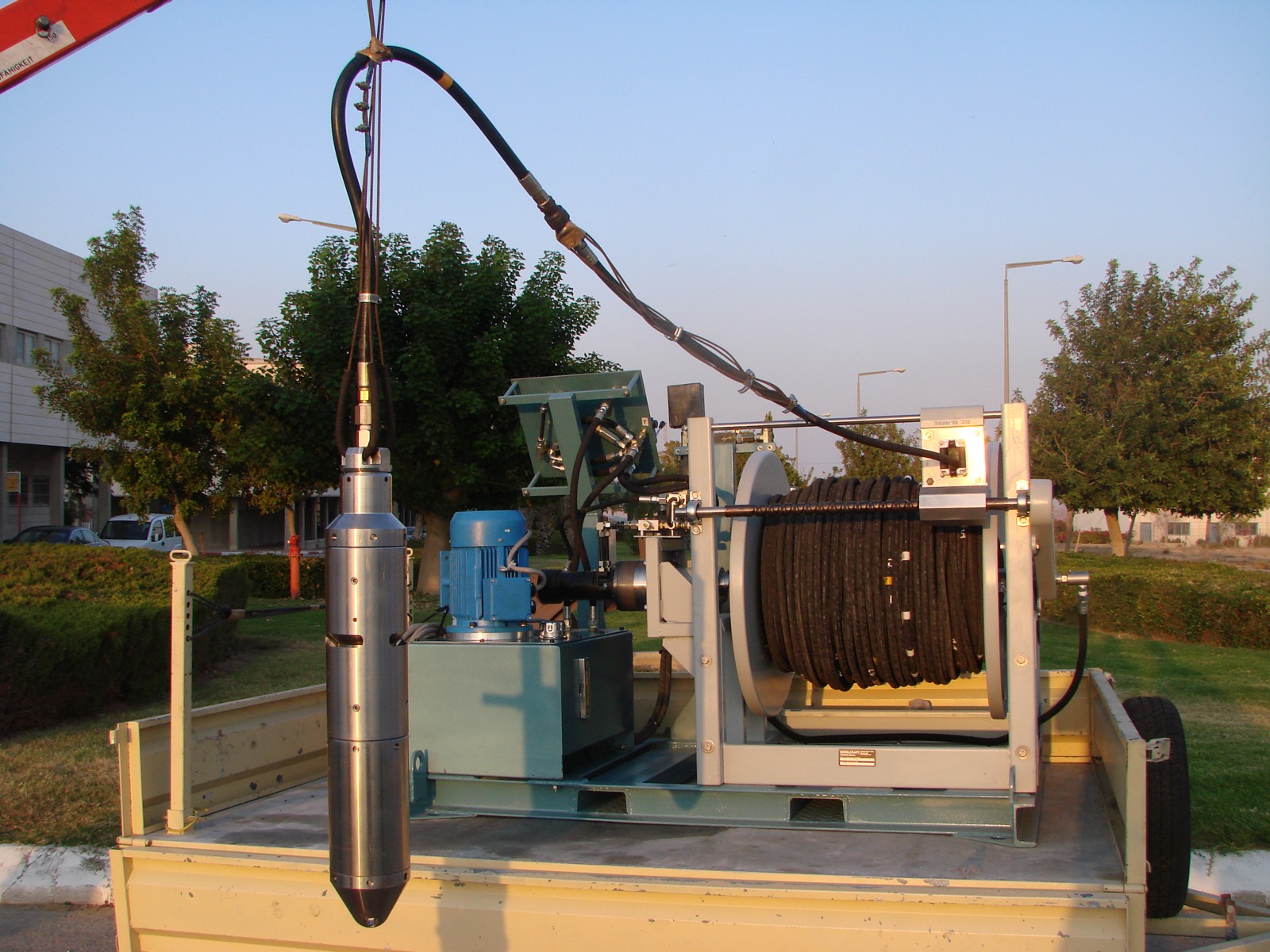
How a pass runs
The reel runs the AIG fast down the blank casing, then slows to a smooth, steady speed through the screen — chosen so the tool's continuous firing delivers 3–5 shots per foot almost automatically. The operator monitors and adjusts speed or direction at the reel manifold. A 100-ft screen takes roughly 15–25 minutes per pass; two to three passes are typical.
Between passes, check the well bottom. The first pass can drop many feet of dislodged debris to the bottom. Sound the depth and remove excess fill (bail or airlift) before continuing — the AIG must not fire inside accumulated debris.
All values are general starting points and do not replace the contractor's site assessment and judgment. Begin conservative; adjust as conditions justify.
Download the AirShock® Field Planning Guide
The full pressure-by-depth table and the gas consumption worked examples, in one PDF for job planning. Enter your details and the download opens immediately.
Used only to send you the guide and follow up on it. No newsletter.
Planning a specific job? Send the well data and interval — we'll recommend AIG model, starting pressure, and a gas plan.