Specific capacity by step test. From Flow Industries' documented treatment archive. The lighter segment shows the range between the two post-treatment readings.
The problem
When this well was built, it delivered a specific capacity of 1.0 m³/h per meter of drawdown. By the time the operator sought help, it produced 0.03 m³/h/m — three percent of its original performance. Pumping 5.4 m³/h required nearly ten meters of drawdown where one meter had once been enough.
A 97% loss of specific capacity is not an aquifer running dry. It is a well whose screen, gravel pack, and near-wellbore zone have progressively sealed with mineral incrustation and biofouling — a hydraulic bottleneck, not a water shortage. This distinction matters, because wells in this condition are routinely written off and replaced.
The treatment
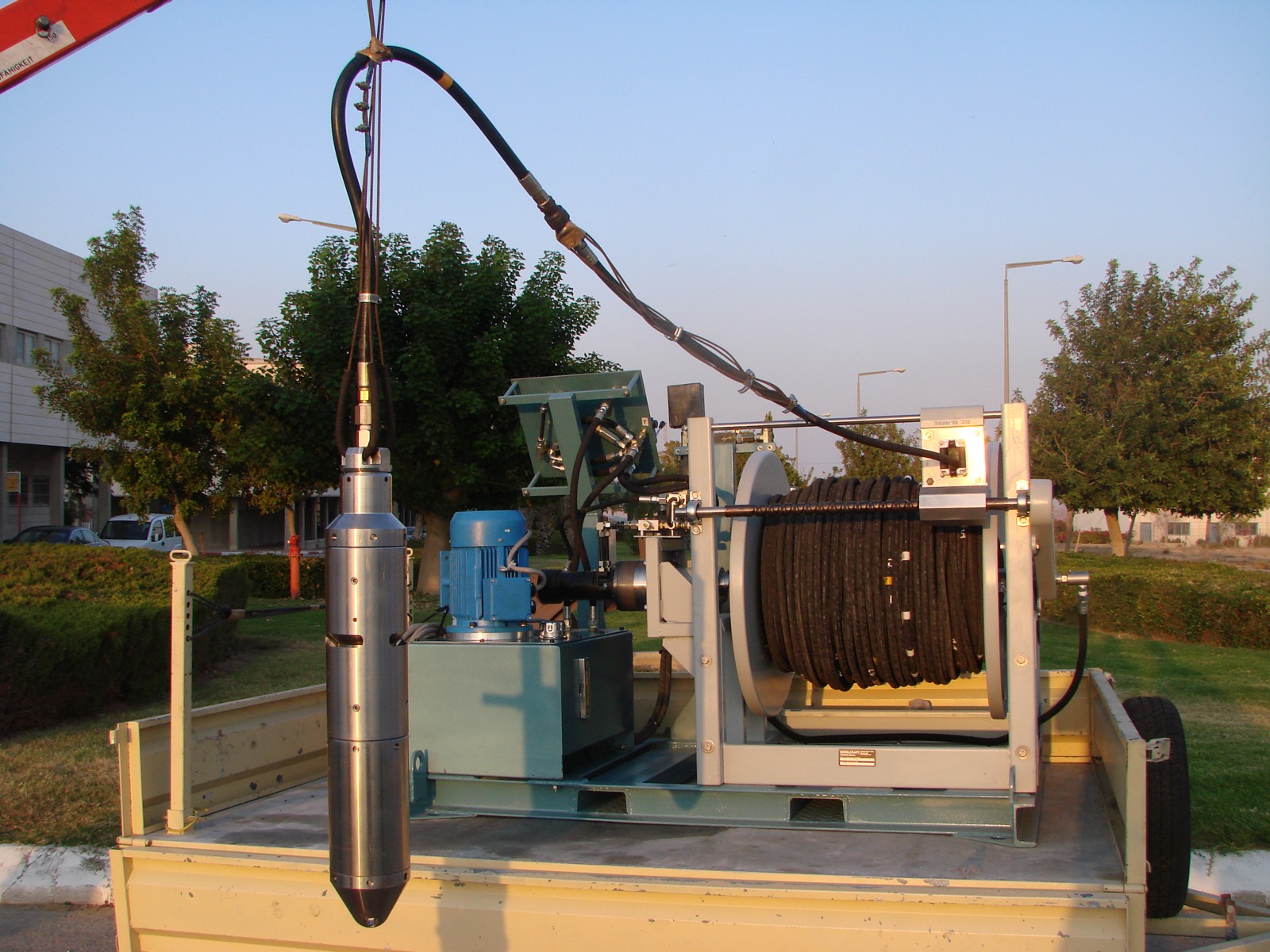
An AirShock® impulse generator was deployed to the screen interval on the hose reel and worked through the clogged zone in controlled intervals. The pressure pulses and oscillating gas bubbles surged water through the screen openings, gravel pack, and formation face in both directions — mechanically breaking the incrustation that years of gradual deposition had built, and carrying the dislodged material into the well bore for removal.
The result
Step tests before and after treatment:
| Specific capacity (m³/h/m) | Drawdown at test rate | |
|---|---|---|
| Original, as built | 1.0 | 7.0 m at 7 m³/h |
| Before treatment | 0.03 | 9.5 m at 0.3 m³/h |
| After AirShock® | 0.93–1.05 | 5.81 m at 5.4 m³/h |
The well recovered to 93–105% of its original as-built specific capacity — from a 97% loss back to essentially its performance the day it was commissioned. The two post-treatment readings bracket the original figure, so the honest statement is a recovery range rather than a single number. That the well reached its original as-built level at all is notable: the impulse treatment appears to have also removed residual drilling damage present since construction.
Why it matters
The economic question this case answers: when is a well dead? This one was, by any conventional measure — 3% of original capacity is deep in "drill a replacement" territory, at many times the cost of a rehabilitation. The before/after step-test data shows what the conventional measure misses: if the water is still in the formation and the loss is hydraulic, the well can come back.
The honest counterpart: not every well in this condition recovers. The outcome depends on what is actually causing the loss — which is why every recommendation starts with the well's construction records, test history, and symptoms, not with a promise.
Results depend on well construction, geology, degree and type of clogging, and correct system configuration.
Have a well that everyone says is finished? Send us its original completion data and the latest pump test — we'll give you a frank assessment of whether it can be recovered.